






































Login
Your benefits:
- Du sammelst mit jeder Aktivität XPs. Gear up und erreiche den nächsten Rang!
- Übersicht über Deine Bestellungen und den aktuellen Bestellstatus
- Schnelle & komfortable Bestellung


The ghillie suit (also called “Yowie suit” in Australia) is a special camouflage suit that doesn’t just rely on patterns and colours, but completely breaks up the human outline. By carefully integrating jute, yarn, raffia and natural materials, the wearer virtually merges with the surroundings – whether forest, meadow or urban rubble field.
Originally rooted in the military, the ghillie suit has long since established itself in other fields: hunting, wildlife photography, airsoft or paintball – anywhere invisibility is a tactical advantage.
The technical effectiveness of the ghillie suit is based not only on its outward appearance, but above all on the combination of material selection, construction and individual adaptation to the terrain.
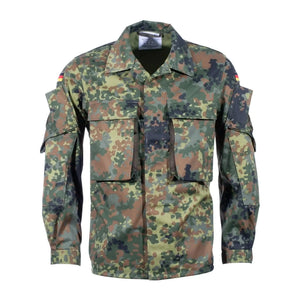
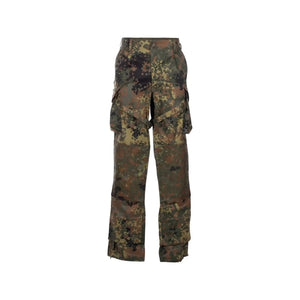
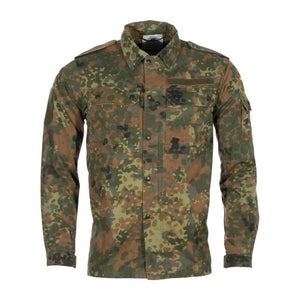
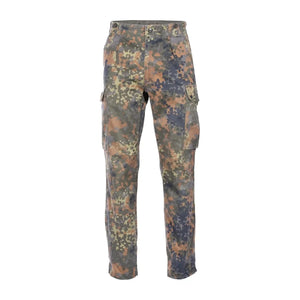
A typical ghillie suit is based on a lightweight mesh fabric as the carrier material. Strips of jute or synthetic yarns are attached to it – by sewing, knotting or hook-and-loop systems. The colors are based on the local environment or on the camouflage pattern of the clothing worn underneath (e.g. Flecktarn).
To further optimize it, natural materials such as grass, twigs or leaves are incorporated. This allows the suit to adapt dynamically to the terrain and achieve three-dimensional camouflage that goes far beyond standard camouflage.
To ensure complete camouflage, a classic ghillie consists of several components that together provide seamless coverage.
A complete ghillie suit generally consists of:
In addition, camouflage gloves and camouflage face paint are often used – especially important to cover light skin areas on the hands and face.
The ghillie suit is no longer reserved just for special forces. Hunters, wildlife photographers and airsoft players also use it to move silently and inconspicuously in the field.
The requirements differ depending on the intended use – and so does the design of the camouflage suits.
Depending on the situation and how much room you have to move, different options are available:
What always matters is the right combination of ghillie type, movement behaviour and adaptation to the terrain.

A ghillie suit alone does not make an invisible hunter. Only in combination with the right behavior does it unfold its full potential – and this is where the crucial difference between beginners and professionals lies.
Camouflage only works if your behaviour matches. A ghillie suit provides excellent concealment – but if you move the wrong way, you’ll still be spotted.
Therefore:
These principles apply regardless of the area of use – whether on the shooting range or when stalking in the wild.
In addition to movement, the physical burden of wearing the ghillie itself plays an important role – especially in challenging climatic conditions.
An often underestimated risk: heat build-up. Especially in warm climates (e.g. jungle or semi-desert), a dense ghillie can become a real burden.
Therefore:
Breaks, fluid intake and self-monitoring are also part of mission preparation.
The history of the ghillie suit is closely linked to Scotland and the hunting tradition of the Highlands.
There, so-called ghillies – gamekeepers – used simple clothing sewn with strips of fabric and camouflaged with earth to observe game or catch poachers. The idea: to move almost invisibly through the landscape without being detected.
The ghillie suit was first used militarily by the Lovat Scouts during the First World War – a special unit of the British Army. From 1916 onwards, they became Great Britain’s first official sniper unit. Since then, the ghillie suit has been closely associated with sniping – and has been continuously developed.
A ghillie suit is a powerful tool for camouflage and invisibility in the field – but only in combination with correct behavior, local knowledge and experience. Those who understand and master it can quite literally make themselves invisible.
Do you use a ghillie suit or other camouflage aids yourself? Share your experiences, tips or questions in the comments and exchange ideas with other members of the ASMC community!

At ASMC Unlimited you will find our expanded range of batons, knives , free weapons , self-defense items , airsoft, air rifles and much more.
Pay securely with:


Secure shipping with:

