






Light My Fire
Fire starter Swedish FireSteel Army 2in1 Bio
19,32 €
16,42 €


It’s Sunday morning, the sun is shining through the treetops as a small group of ASMC employees and friends meet in a patch of forest in the Saarland. Actually, these are perfect conditions for a walk. But our goal is different: to learn how to survive outdoors when it really counts.
To do this, we attend a survival course with KB Trainings. The instructors Florian and Jan, both active soldiers with decades of experience, introduce us to the basics of survival.
The focus of the training is on which equipment you need to survive in emergency situations, how to use it, and how to use aids from nature or even trash to survive.
Survival is about fighting against everything that can immediately threaten life in an extreme situation: cold, wet, hunger, thirst, disorientation, exhaustion, fear. Anyone who wants to cope outdoors – without modern aids, cut off from civilization – must learn to manage with scarce resources, make clear decisions and correctly prioritize their own needs.
Imagine you are a survivor of a plane crash – somewhere in the middle of nowhere. Or your vehicle breaks down in a remote forest area, far from the nearest town.
No reception, no GPS signal, the batteries of your smartphone and smartwatch are dead. You can either hope that someone comes by or try to get help. Without functioning technology, navigation suddenly becomes anything but easy.

On the course we learned how to use map and compass, what the UTM grid used by the military is all about, and how to reach a destination using the march bearing and the double-step method.
Jan proved that it can be done without a compass. Using sticks, he built a compass on the forest floor that can be used to determine the cardinal directions – but it only works on sunny days.
Knots are not only useful in survival situations – they’re true all-rounders for everything that happens outdoors: when setting up an emergency shelter, guying out a tarp, hanging a hammock or even building an improvised stretcher for casualty transport.
It quickly became clear in the course: it’s not about learning dozens of complicated knots – but about mastering a handful of useful knots for different purposes properly. Particularly practical, for example, are knots that tighten but can be released with a single movement. Ideal for tensioning tarps or tarpaulins. Then there are adjustable knots that allow the rope length to be adapted – they remain stable under load but can be readjusted if necessary. Such knots are especially helpful when you want to guy out tents or securely hang a hammock.
Safety knots were also demonstrated – important, for example, for improvised stretchers or for securing equipment in rough terrain.
This is how it was in practice: Some knots didn’t work perfectly right away. But as we all know, practice makes perfect, and regular practice helps ensure that your movements are spot on even under difficult conditions such as cold.
One of the most striking lessons in the course was building simple traps – to secure survival in a real emergency. While plants, berries and mushrooms may be edible, they often don’t provide enough energy to remain capable over the long term. Animal protein and fat, on the other hand, supply exactly the calories you need to survive – especially in cold conditions, under physical strain and with lack of sleep.
The knot skills learned beforehand were put to immediate use in trap building: loops, trigger mechanisms, tensioning systems – all of this only works if the knots hold and can be tied quickly.
The right tools are also helpful for building traps: a fixed-blade knife is sufficient here. Even better is a hand saw or an axe.
In addition to the technical construction of the traps, the focus was also on recognizing tracks, interpreting animal paths and placing traps as inconspicuously and effectively as possible.
However, the legal note was also important: outside of genuine emergency situations, setting traps is prohibited in Germany. The techniques shown are intended exclusively for emergencies – and that is exactly the focus with which they were taught.
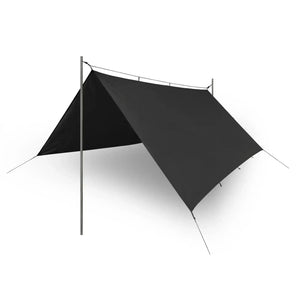
A dry sleeping place is essential in survival situations to avoid hypothermia. With a tarp, some paracord and two trees, you can quickly set up a simple shelter. If no rope is available, a PET bottle can serve as a practical substitute – in the forest you’ll often find trash that can be repurposed. Using a knife, you can cut it into a spiral to create a strip about finger-width. The resulting “cord” can be used as an improvised attachment aid.
Alternatively, you can use a rain poncho that protects you from rain during the day and can be converted into an emergency shelter at night. It’s important to close the hood tightly to prevent water from getting in.
For insulation against ground cold, natural materials such as brushwood in coniferous forests or a thick layer of leaves in deciduous forests are suitable. A simple bed made of branches also protects against moisture and cold from the ground.
What we learned: Improvising with what you have is an essential aspect of survival. The gear you carry can be very helpful here. In particular, a Rescue blanket is light and compact and a true all-rounder: it keeps you warm, reflects body heat and can be used as sun protection in great heat to prevent dehydration and sunstroke. In addition, the emergency blanket can also be used for water collection by using it to catch condensation or rain.

Without water, a human can only survive for about three days – which is why obtaining water is one of the most important survival skills. Ideally, you find a spring, a stream or another natural body of water. But even clear water can contain germs that can become life-threatening. Therefore, the rule is: always boil or filter water before drinking it.
A compact Water filter is a real advantage when you’re on the move – but often not available. In such cases, it’s time to improvise. With a bit of trash from the woods, for example a PET bottle, you can build a simple filter. Several layers of sand, stones, charcoal or even cotton wool help filter out coarse impurities. A piece of fabric over the opening can serve as an additional filter stage.
Important: Even after filtering, the water should be boiled to reliably kill germs.
If there is no water source nearby, there is another option: obtaining water through condensation. A garbage bag placed over a leafy branch and sealed tightly collects condensation water over several hours due to solar radiation – not much, but in an emergency every drop counts.
The rescue blanket proves to be a real all-rounder: it not only protects against hypothermia and serves as heat protection in strong sunlight, but can also be used for water collection by catching rain or condensation.
What we took away from the course: Sourcing water is often labour-intensive and time-consuming. If you only act once you feel thirsty, you’re already dehydrated. That’s why you should take care of obtaining and treating drinking water at an early stage. Finding water and making it drinkable is not automatic – it takes preparation, knowledge and sometimes creativity.
Fire is especially vital for survival in cold and wet conditions: it provides warmth, helps you dry your clothes, boil water and prepare food. A small helper with a big impact here is the ferro rod.
Before you light the fire, you should have all materials ready to hand – otherwise it will quickly go out again. Birch bark, tampons or Fatwood. Once the flame is there, it is fed with fine, dry twigs.
However, depending on the weather, finding dry wood is not always easy. That’s why it’s worth collecting suitable bark or deadwood during the day and storing it in a dry place – for example in a small pouch or the outer pocket of your backpack. This makes lighting the fire in the evening much easier. Resin is also ideal as a fire starter.
Insights from the course: Making fire without a lighter is anything but easy. Even under ideal conditions, we didn’t manage to start a fire with a ferro rod right away. Without a ferro rod, making fire becomes even more difficult and requires a lot of practice – for example with the bow-drill method.

The courses offered by KB Trainings in survival/bushcraft, self-defense, firearms training as well as the medic course can be booked at www.kb-trainings.de.


BeFree Tactical 1.0 Liter filter system black


Bivouac Sack Special Forces Bivvi Bag WGTE

Headlamp NU35 Dual Power
Pay securely with:


Secure shipping with: