





























Login
Your benefits:
- Du sammelst mit jeder Aktivität XPs. Gear up und erreiche den nächsten Rang!
- Übersicht über Deine Bestellungen und den aktuellen Bestellstatus
- Schnelle & komfortable Bestellung


This article was written by ASMC ambassador and photographer Fips Neukamm.
Dust lies on the forest floor, the dried moss cracks and rustles with every step. The sun fights its way through the pine crowns; it’s mid-May and the air in Brandenburg is surprisingly mild for the season. 15 degrees, sometimes sunshine, sometimes gray clouds. Four people, one goal: to learn how to save lives – even when you’re in a bivouac somewhere far from trails, cell reception or help.
The course instructor’s name is Chris. He has been working in medicine for 23 years, the last 12 of them exclusively in emergency care. Experience abroad, hospital, emergency medical services – what defines him: his heart beats for situations in the great outdoors. Bushcraft, urban exploration, LPs. When he founded B.L.E.E.D.-Survival, he wanted to bring two worlds together: modern emergency medicine and rugged outdoor life. Stopping bleeding between trees, saving lives without a hospital corridor, navigating without Google Maps. Not because it’s cool, but because it’s necessary.
The day starts quietly. After a brief round of introductions, we’re standing in the middle of a pine forest, each with a tourniquet, rescue blanket and Israeli bandage in our backpack. Chris’ words are direct: “The first minutes decide – not whether you place an emergency call, but whether you bleed out or live.”
What follows is no sterile training. No projector, no flip charts. Instead: “Imagine your buddy accidentally hacks his thigh with a machete. You’re two hours from the nearest forest road. What do you do?” Theory becomes practice. And practice becomes routine.
We apply pressure bandages, stop simulated arterial bleeding with tourniquets, and treat head and chest injuries with improvised means. It’s about doing, not talking.

The MARCH protocol (Massive bleeding, Airway, Respiration, Circulation, Hypothermia) serves as a guide: how do I set priorities when I suddenly find myself the only one who can help? Chris demonstrates, explains, allows mistakes. “Only those who make mistakes remember how to do it better.”
The participants appear focused, sometimes quiet. Not out of insecurity – but out of respect for the subject. This is not about first aid for a driving test. It’s about what to do when help no longer arrives in time. And after a while, even though the situation is simulated, it feels damn real.
15 degrees in the shade – mild, but not after significant blood loss. Chris shows how to protect someone with hypothermia – with a bivvy bag, a space blanket, an improvised shelter. It’s not just about “wrapping them up warm”, but about strategic thinking: wind direction, ground pad, insulation from below. Someone who is hypothermic has less time if they’re also wounded.
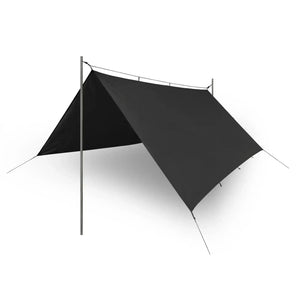
We build small camps with emergency means: tarp, paracord, tarp, bark. Even under difficult conditions. Sometimes the rope snaps, sometimes the tarp flies away – all part of the plan. “It won’t look pretty, but it will work.”
Splints, shoulders, sprains, fractures of arms and legs – often while hiking or from a fall on a slope. Chris shows us how to build improvised splints using a sleeping pad, trekking pole and belt. They are secured with triangular bandages and courage. We also learn how to splint with a SAM splint – and most of us would have ordered one on the spot if we’d had reception.
Then: transport. If someone can no longer walk, you either stay with them – or carry them. Sounds simple. It isn’t. Rescue sheet or improvised patient transport using carry handles, branches, tarps – here muscle power becomes a factor for survival.
Compasses, maps, the position of the sun – not rocket science, but hard to apply when you’re panicking. Between bandages and tourniquets we learn how to roughly keep our bearings in the field, recognize landmarks and plan simple return routes.

Because you never know when things will get serious. Someone might fall while hiking, a tree might topple, you might slip with your knife. Those who can act then have more than knowledge – they have tools. And courage.
Four participants, one weekend, many stories. The photos I took don’t show a step-by-step guide on how to save lives. But they do show what it can look like: the focused face while applying a tourniquet. The hands that tremble as you remind yourself that mistakes can be fatal. The moment when an improvised shelter actually stands – and the group realizes that it’s not about style, but about protection. This is not about tacti-cool medics, but about preserving a life if it comes to the worst.
B.L.E.E.D. Survival is not a bushcraft course with a bit of first-aid stuff. It’s medicine, outdoors, real – and damn important.


Shipping to Almost Everywhere
Shipped to you within 1–2 business days

Completely risk-free
Top reviews, certified shop & 31-day satisfaction guarantee

Pay flexibly
Pay securely and flexibly with PayPal and more

Loyalty is rewarded
In the ASMC Prime League, you'll receive attractive discounts
Pay securely with:


Secure shipping with: