








































Login
Your benefits:
- Du sammelst mit jeder Aktivität XPs. Gear up und erreiche den nächsten Rang!
- Übersicht über Deine Bestellungen und den aktuellen Bestellstatus
- Schnelle & komfortable Bestellung


The tarp, also known as a tent sheet or tarpaulin, is a versatile and popular piece of equipment among outdoor enthusiasts. It serves as a weatherproof cover to protect against rain, wind and sun. Depending on the weather and your individual needs, there are different ways to pitch and use a tarp. Experienced campers know that the A‑frame is ideal for sunny weather, while the C‑fly or the “toad” setup are excellent for bad weather. In this article, we’ll show you the 4 most common tarp configurations so that you’re well prepared for any situation.
Before we turn to the various tarp setup options, we should first clarify which materials are actually needed to pitch a tarp. These include:
There are numerous tarp setup variants tailored to different weather conditions. Below we present four common setup options that will have you well prepared for any weather. All of the following configurations can be built using our low-cost square and rectangular multipurpose tarps.
The lean-to tarp setup is a very simple but effective way to create a windbreak even with smaller tarps.
The structure is particularly versatile, as it can be built in different versions and sizes and adapted to individual needs.
The lean-to is tensioned diagonally between two anchor points (e.g. trees or branches) and fixed to the ground with pegs. The tarp should face the direction the wind is coming from. To stabilize the tarp, an additional guy pole is set up at the front of the tarp to create a slope.
The lean-to offers good protection from the wind. However, since the tarp otherwise remains completely open, a lot of heat escapes. Protection from rain is also limited, especially when the wind direction changes.
The C-fly tarp setup is an advanced and very stable construction that is particularly suitable for longer camping stays. The C-fly is similar to the lean-to, but its extended sloping roof and groundsheet provide better protection from rain and cold ground.
The setup is similar to that of the lean-to. However, part of the tarp is used as a groundsheet. Another part is needed to form a short, sloping roof. To do this, a rope is tensioned parallel to the side that is fixed to the ground.
The C-fly offers excellent protection against rain, wind and sun. The sloping roof surface allows water to run off quickly, while the additional tarp at the front provides extra protection from the wind. The groundsheet protects the sleeping pad from dirt and sharp objects such as branches and stones.
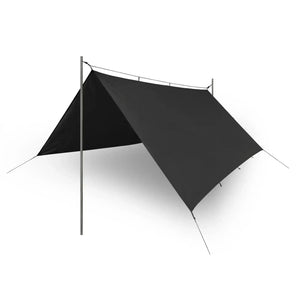
The A-frame is a popular tarp setup variant that is characterised by its triangular shape. It is a simple but robust construction that, thanks to its shape, offers good stability and protection from wind and rain.
Setting up the A‑frame is relatively simple and can be done by one person alone. To do this, two tarp poles (or alternatively trekking poles or branches) are set up at an angle of about 45 degrees and connected on the opposite side with a crossbar. The tarp material is then hung and secured between the poles. The result is a triangular, tapering tent with a low, flat entrance area.
The A-frame is particularly suitable for dry weather or light to moderate rainfall, as the tarp material offers good waterproofing and the triangular shape withstands the wind. In strong wind or heavy rain, however, the shelter can be more susceptible to moisture ingress, as it is less enclosed than other tent shapes.
The “toad” tarp setup is a simple yet robust construction for outdoor use. With this variant, almost all sides are closed, providing a great deal of protection. The name “toad” comes from the fact that the shape of the setup resembles the body of a toad.
To set up the "toad" shelter, first pitch the tarp pole. Then lay the tarp over it and secure the sides to the ground with guy lines or cords. One side of the tarp is then folded down and also fixed to the ground with guy lines. This creates a triangular structure that is open at the sides and only closed by the folded-down tarp.
The “toad” setup offers good protection from wind and rain and is particularly suitable for light rainy days. In strong wind or rain, you can secure the tarp at the sides with additional guylines or cords to provide more stability.
To set up the tarp under time pressure before nightfall or an approaching storm, you need practice. Therefore, beginners in particular are advised to rehearse pitching the tarp tent before the actual camping trip. Beginners should also keep the following helpful tips in mind:


Shipping to Almost Everywhere
Shipped to you within 1–2 business days

Completely risk-free
Top reviews, certified shop & 31-day satisfaction guarantee

Pay flexibly
Pay securely and flexibly with PayPal and more

Loyalty is rewarded
In the ASMC Prime League, you'll receive attractive discounts
Pay securely with:


Secure shipping with: