



































Login
Your benefits:
- Du sammelst mit jeder Aktivität XPs. Gear up und erreiche den nächsten Rang!
- Übersicht über Deine Bestellungen und den aktuellen Bestellstatus
- Schnelle & komfortable Bestellung


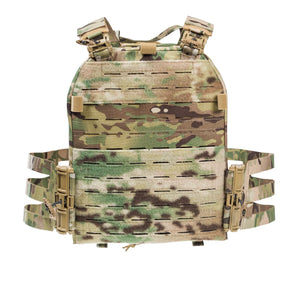
Protective vests provide essential protection against stab and gunshot injuries. Depending on the threat situation, different models are used – from stab-resistant vests to bulletproof vests, also known as ballistic protective vests. Here you’ll find out which vest is suitable for which purpose and what you should look out for.
Stab-resistant vests protect against attacks with knives, needles and similar pointed weapons. They are often designed as discreet under-vests that can be worn beneath clothing – ideal for private individuals, security personnel and businesspeople.
Stab-resistant vests are a lighter alternative. They do not offer complete protection against stabs, but they cushion the impact and are therefore more comfortable. Which option is right depends on the threat situation.
The protective effect is created by several millimetres of thick plastic plates, often supplemented by aluminium plates in the chest, abdomen and back areas. The outer material is usually made of hard-wearing polyester.
Stab-resistant vests usually weigh between 1.5 and 2.0 kg, as they are designed for flexibility and wearing comfort.
Stab-resistant vests are divided into four classes according to the "Test Guideline for Stab and Impact Protection" (VPAM):
K1: Basic protection against lighter stabbing weapons
K2: Increased protection against stronger stabbing attacks
K3: resistance to powerful stabbing attacks
K4: Maximum protection against extreme threats
Bulletproof vests, also known as ballistic protective vests, stop projectiles and prevent them from penetrating the body. They are indispensable for police, security services and soldiers. Hunters also use them for protection against ricochets.
In some cases, a stab-proof vest can be the better choice – for example for bouncers, who are more likely to face knife attacks.
In Germany, the "Technical Guidelines for Police Protective Vests" are decisive. There are four protection classes (SK):
SK 1: Protection against handgun ammunition (e.g. revolvers, pistols)
SK 2: Extended protection against more powerful handguns
SK 3: protection against rifle ammunition
SK 4: Protection against rifle ammunition with hard core
The police generally use bulletproof vests of protection level SK 1, as these provide protection against handgun ammunition while still being light and comfortable – ideal for everyday duty. These vests weigh around 2.0 to 3.5 kg.
The Bundeswehr, on the other hand, uses SK 4 vests for foreign deployments. These offer the highest level of protection against rifle ammunition and are therefore essential in combat zones. The Bundeswehr often combines these vests with additional protective plates to protect vital organs as effectively as possible. SK 4 models can weigh up to 30 kg – the extra weight is accepted in order to ensure maximum safety.
As a rule, you may wear protective vests anywhere – except at public events and demonstrations. Here, the Assembly Act applies, as such vests could be interpreted as protective measures against state intervention.
Whether in the private sector, with security services or in use by the police and Bundeswehr – the right protective vest can save lives.

At ASMC Unlimited you will find our expanded range of batons, knives , free weapons , self-defense items , airsoft, air rifles and much more.
Pay securely with:


Secure shipping with:

