






































Login
Your benefits:
- Du sammelst mit jeder Aktivität XPs. Gear up und erreiche den nächsten Rang!
- Übersicht über Deine Bestellungen und den aktuellen Bestellstatus
- Schnelle & komfortable Bestellung


Camouflage patterns are more than a fashion detail – they serve a tactical purpose. Whether on duty, on the airsoft field or during outdoor training: if you want to remain undetected, you need to reduce your visual presence. It’s not just about colours, but also shapes, contrasts and textures that adapt to the specific environment – such as forest, desert or urban terrain.
Various patterns have been developed for this purpose, each tailored to specific geographic regions, vegetation types, and lighting conditions. Some are considered universal, while others are designed for specific scenarios. The better the pattern matches the environment, the lower your visibility – a clear tactical advantage. Camouflage works even better when you complement it with natural elements like grass, leaves, or branches from the surroundings to blend in perfectly.
In this blog post we show you the most important international patterns as well as special camouflage designs and their ideal areas of use.
Not every terrain demands the same camouflage. This selection shows which pattern is most effective where:
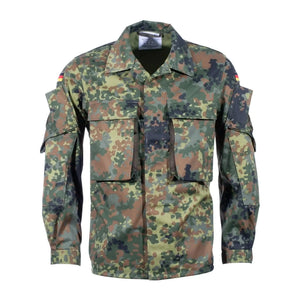
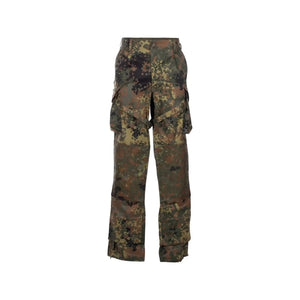
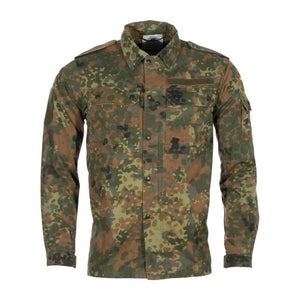
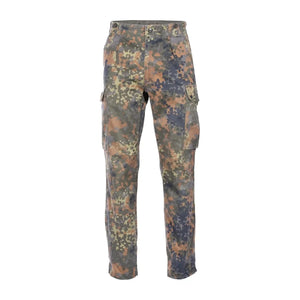
 Pattern: Flecktarn
 Pattern: Tropentarn
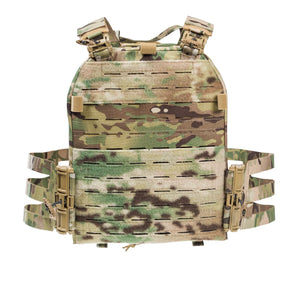
 Pattern: Multicam
 Pattern: Woodland
 Pattern: MARPAT
 Pattern: CCE camouflage
 Pattern: CADPAT
 Pattern: MTP
 Pattern: Austro-camouflage
 Pattern: M90
Camouflage is international – but not identical. Each country develops patterns tailored to its native terrain – from Canadian coniferous forests to the Mediterranean region.
In addition to color schemes, technologies have also evolved:
Digital camouflage patterns such as CADPAT or MARPAT use pixel structures to be more effective at medium distances and to disrupt optical systems. Such patterns break up outlines effectively and are harder to capture digitally.
Equally important today is the IRR camouflage (infrared reduction), which reduces visibility under night vision devices – a clear advantage in modern operations. Materials are also increasingly optimized multispectrally to ensure effective camouflage both day and night.
Today, camouflage is a precise interplay of design and technology – tailored to terrain, threat, and tactical purpose.

Dark colors, hardly any contrasts, minimal reflections – ideal for night operations in low light. Developed for covert movement in the dark.

Light sand and brown tones, low contrasts – ideal for open, dry landscapes. Developed for maximum camouflage in bright sunlight. Typical examples: desert camouflage of the Bundeswehr, three-color desert of the US armed forces.

Muted gray tones, soft transitions – optimized for urban environments with concrete, steel and glass. Effective when moving through urban terrain.

Dark brown and green tones with soft transitions – suitable for damp, dense vegetation. Popular for duck hunting, fishing, and camouflage in swampy terrain with heavy shading.

Pixelated structure instead of soft transitions – developed for camouflage at medium range and against digital targeting systems. Examples: Left: CADPAT (Canada); Right: Scorpion (France).

Light white and gray tones, sometimes with pale blue – developed for snow-covered landscapes. Ideal for camouflage in snow, ice and open winter terrain in diffuse light.
| Environment | pattern |
|---|---|
| Forest areas with mixed vegetation | Flecktarn, CADPAT |
| Rocky ground with fog | M90 |
| Urban and industrial areas | Urban Gray, UCP |
| Dry, open areas | Tropentarn, Three Color Desert |
Whether you’re putting together a realistic loadout for airsoft, operational training or outdoor adventures – in the ASMC shop you’ll find a huge range of gear with proven camouflage patterns.
From classic Flecktarn and Multicam to specialized patterns for desert, urban environments, or night. Our product range includes functional clothing, camouflage nets, accessories, and equipment details. All products are field-tested and come from brands known for quality and everyday tactical reliability. This allows you to perfectly tailor your setup to your operational environment – whether you’re camouflaging in the forest, moving through urban areas, or mastering extreme conditions.


Camouflage patterns are more than a visual feature – they are a tactical tool. The better your pattern matches the environment, the harder you are to spot. Whether you want to move inconspicuously in the field, blend in your gear or simply build a realistic loadout: the right camouflage can be decisive. Know your environment. Choose your pattern deliberately. And gain the advantage of invisibility.
Which camouflage color is most effective in densely forested areas?
For which environment is the “Flecktarn” pattern particularly suitable?
Which camouflage pattern uses digital pixel structures for camouflage at medium range?
If you are moving through mixed terrain of meadow, foliage and shade, which combination of camouflage pattern and accessories makes the most sense?


Shipping to Almost Everywhere
Shipped to you within 1–2 business days

Completely risk-free
Top reviews, certified shop & 31-day satisfaction guarantee

Pay flexibly
Pay securely and flexibly with PayPal and more

Loyalty is rewarded
In the ASMC Prime League, you'll receive attractive discounts
Pay securely with:


Secure shipping with: